Modernization of Route Planning & Dispatching App
Role
UX Architect
Client
WM
Timeline
3 Years - 2021-2024
Project Overview
WM is an industry leader in comprehensive waste management services, including garbage collection, recycling, disposal, and dumpster rental.
They serve ~21 million residential, industrial, municipal, and commercial customers across the US & Canada.
This project focused on redesigning the Core Business Application for Route Planning & Execution Management, used by ~2,000 Operations Analysts across 565 sites.
Problem context
The legacy application struggled to meet modern operational demands. The company has taken initiative to modernize the application to improve and optimise operational efficiency.
Challenges with the legacy system:
-
Outdated architecture limited scalability and data visualization.
-
Realtime data was unreliable, making quick decision is difficult.
-
Users had to rely on multiple systems to check operational status.
Design Process
-
Requirement Analysis
-
Design Workshops + Surveys
-
Journey map
-
Ideation and Solutioning
-
Task flows & IA
-
Wireframes
-
Prototypes
-
Visual Design
-
Development
-
Pilot Release
User Research
I along with my team, collaborated closely with the business users (Planners & Dispatchers) during the requirement and design workshops to gather their inputs and identify their pain points. Understood what works well in the current system and the limitations.


Key Pain Points Identified:
-
Inaccurate or unreliable realtime data for making timely decision.
-
Improve routing challenges like unfamiliar site routing, manual container matching.
-
Better way to handle realtime challenges like Priority tickets, breakdowns and traffic and diversion.
. -
Lack of unified view for fleets, assets, sites, and drivers.
-
Limited forecasting ability with the existing tool.
-
No data analytics capability for monitoring and calculating efficiency in the current system.
-
Need to improve Customer experience
Concepts & Ideation
During ideation, we explored ways to make route execution more intuitive and transparent for planners and dispatchers.
The concept of a Gantt-based timeline where each route will have its own pin heads moving along the timeline and visually indicate the service progress and status in real time.
Through multiple iterations and feedback cycles with users, this design evolved into an interactive planning sandbox that not only improved situational awareness but also made monitoring and adjustments more engaging and efficient.

User Flows
To validate the design direction, We created detailed user flows mapping how planners, dispatchers would interact with.
These flows highlighted critical decision points, dependencies, and user actions, ensuring the Gantt-based planning experience aligned seamlessly with real-world workflows.

The Solution
AI ML engine powered routing and dispatching
-
An AI/ML Route Optimization Engine will match the containers, automate and plan the best possible routes based on historical data as and when a ticket enters the system. This system works round the clock without any time constraint.
-
Gantt-based drag-and-drop route planning interface act as gamification and also better visual confirmation for manual planning.
-
Planner will review and edit (if needed) the automated route suggestion and save it for next day's execution.
-
Unfamiliar sites can be easily handled by a new router as AI takes care of the heavy lifting part of the auto route suggestion.
-
Realtime route progress in a visual gantt chart for the dispatchers for a better data consumption visually than just table data like in the legacy system.
-
Realtime data sync helps for timely decision and increased efficiency.
-
Re-routing/Re-assign is not difficult anymore as AI engine picks and matches the best slot.
AI based auto assist functionality. Users can accept if everything is looking good or can make changes and save the route.

Gantt based route progress with progress markers for each route and different statuses for better monitoring.

Integrated Here map with realtime vehicle progress for better realtime route progress visibility.

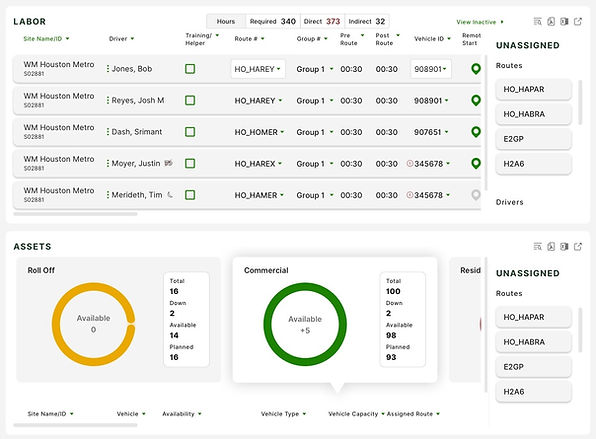
Unified Operations View
All realtime fleet, asset, site, and driver data consolidated into one platform which is key to make informed decisions..


Efficiency Tracker
Introduced daily route scoring based on performance. This is calculated in realtime and the data is available for further optimization and analytics.
Style Guides & Components


Outcomes
5 Miles
Avg. 5 Miles saved per trip through Efficient Route Matching
5 Min
Faster Re-Routing, Re-Assigning. Average came down under 5 Minutes from an average of 25 Minutes.
70%
70% decrease in manual effort in route planning
20%
20% reduction in customer escalations tickets and SLA metrics has been improved.
4 Days
Forecast ability improved to 4 days from 14 days with new AI auto assist.
Although the project faced several unexpected challenges, our team adapted quickly making critical strategic and technical decisions on the go to ensure feasibility.
Future scope
There is still scope for improvements and one problem that we identified on the way is the "Empty Return".
Vehicles used to drop off empty dumpster containers and pick up once it is full from customers site.
